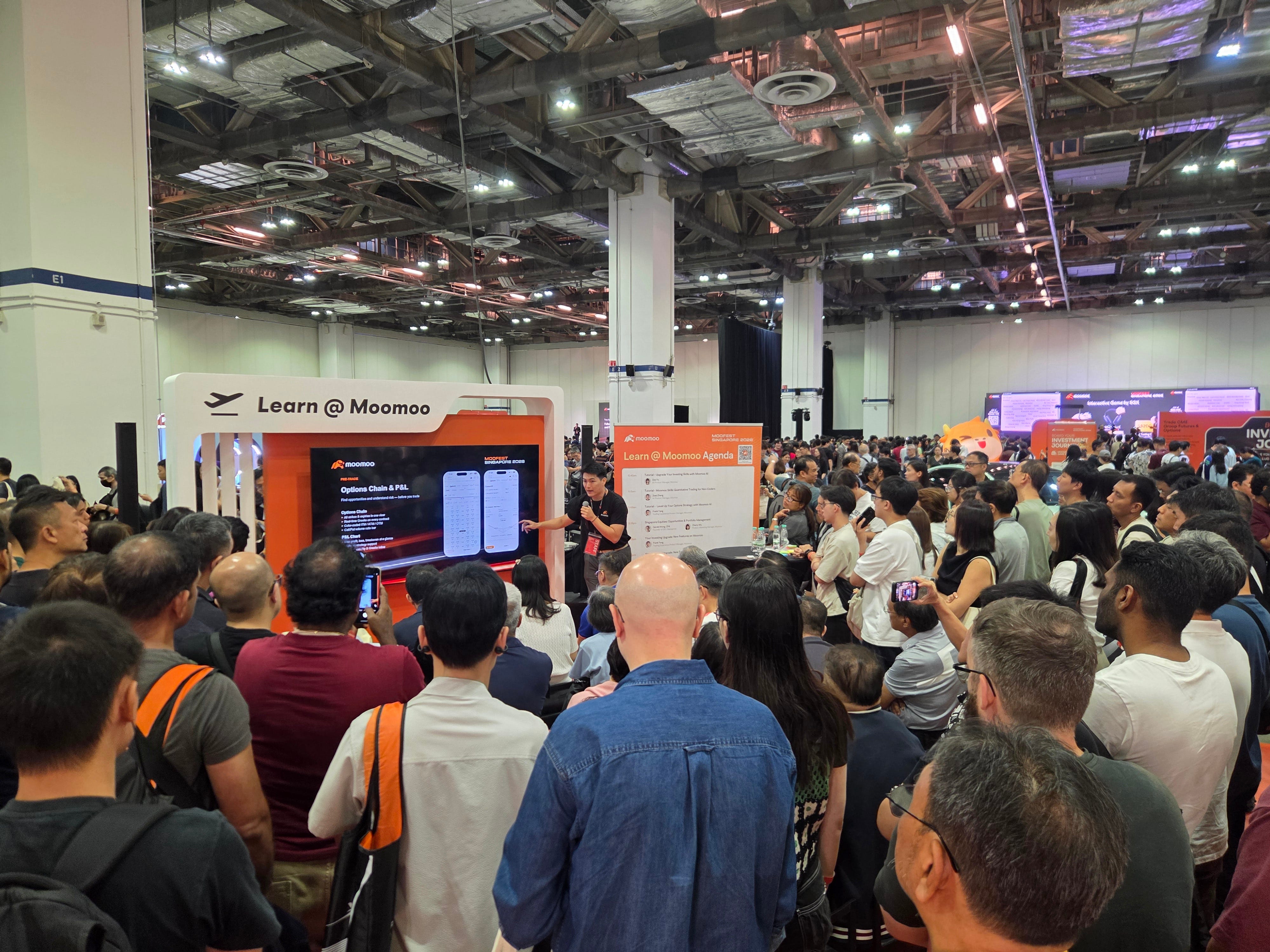

Trading apps have popularized, and certainly also gamified, investing. They opened up access to financial markets for millions of small savers chasing for big fortunes.
Thousands turned up last weekend to the Moofest, Singapore’s largest retail investor event. They came to chase freebies and give-aways, but also to learn about the latest craze: options and futures that involve leverage.
Chinese brokers such as Moomoo, organizer of the event, and Tiger Brokers have made inroads in this segment and gained market share, especially among the speculation-minded Asian populations. In the West, firms like Robinhood introduced frictionless stock trading on the phone and keep expanding at lightning speed with new features.
Korean retail investors lifted the country’s tech stock-heavy Kospi index, which earlier this year saw a massive speculative boom, mainly propelled by leveraged bets on firms that benefit from an elevated AI chip demand. They pushed the benchmark index to double before it plunged into a sharp bear market correction.
The AI boom equally captured investment brokers. As people increasingly turn to their preferred AI models before consulting a doctor, lawyer, or financial adviser, trading apps have upgraded their tool boxes to cater to this new type of demand. They allow investors to upload a breakdown of their assets, preferences and life objectives to get an evaluation and financial plan in return.
Robinhood's yearly product event earlier this month proposed new AI-driven "agentic trading" features enabling customers to plug their personal agents into their system. Depending on the type of query or prompt, users will be routed to the cheaper conventional FAQ catalog, or if necessary, to an expensive and compute-heavy frontier model.
Blockchains ready for prime time
Robinhood also introduced its own blockchain-based digital exchange (DEX) in order to speed up execution and settlement of trades. The public chain, which is built with Arbitrum technology as a layer 2 on Ethereum, supports 24/7 trading of tokenized stocks and crypto. It allows decentralized finance (DeFi) instruments like lending where users can lock in their stablecoins to earn a return.
The company is entering the terrain of native crypto exchanges, like Coinbase, who themselves have started to offer the tokenized variety of traditional equities. Blockchains that track and secure digital assets finally seem to gain in adoption and utility after years of infrastructure build-out. A decade back, the famous slogan ‘blockchains not bitcoins’ made the rounds in TradFi circles, where established firms explored the idea to use them due to their immutable and transparent ledgers, allowing fast transactions and settlement.
In the first three weeks of its existence, Robinhood's chain reached $9 billion of cumulative DEX volume, overtaking the Singapore-based shooting star Hyperliquid, which popularized perpetual futures, “perps,” on indices and commodities, largely benefiting from an increase in market volatility after the start of the Iran war.
In Robinhood's case, however, so-called meme coins still account for the lion's share of the volume. Tokenized real-world assets, nevertheless, are expected to become the main driver of activity in the near future.
Where's the leverage?
RWA’s and perps have become the latest crypto growth story, following in the steps of stablecoins. Monthly RWA volumes across exchanges have grown from about $85 billion in January to about $470 billion in June, according to data from The Block.
Tokenized equities benefited from pre-IPO trading of SpaceX stock, as well as from demand for futures of semiconductor names such as Micron or SK Hynix. Crypto exchanges on top offer leverage and round-the-clock trading.
Traditional venues are alarmed. Both Nasdaq and the New York Stock Exchange will switch to 24/5 trading by end of the year. Representatives speaking at the Moofest pointed to the much higher liquidity and trust that should help to fight off the digital newcomers. At least for the time being.
At its own event, Robinhood mentioned that it received the green light from MAS in Singapore and started offering by-invitation-only service in the city-state. If and when it will offer perps or tokenized stocks remains unclear. Clients can buy crypto for now through the licensed partner exchange Bitstamp. In Indonesia, Robinhood acquired the local brokerage firm Buana Capital Sekuritas and digital asset trader Pedagang Aset Kripto.
Moomoo doesn't work with a third party in Singapore when it comes to crypto, however it uses Fireblocks as custodian. The company didn't mention and seems not to plan to have a blockchain at this point.